
Evening Grosbeaks can exert so much pressure with their bills that they can crack cherry pits, a feat very few songbirds can accomplish. Their historical expansion across the eastern United States was strongly influenced by the planting of box elder trees in towns and homesteads. Although they are songbirds, they lack a complex song repertoire and communicate mostly with a few clear, ringing call notes. They occasionally migrate at night even though their name suggests a connection with evening behavior that does not truly exist. Large flocks can travel many miles in a single day while searching for food, especially during irruption years. When a flock takes off, their strong wingbeats produce a distinctive whooshing sound that is audible from several yards away. During winter, their gizzards grow larger to accommodate the high volume of hard seeds in their diet. Compared to many finches, they show relatively low levels of fear around humans and often allow closer observation at feeders.
Evening Grosbeaks can exert so much pressure with their bills that they can crack cherry pits, a feat very few songbirds can accomplish.
Although they are songbirds, they lack a complex song repertoire and communicate mostly with a few clear, ringing call notes.
They occasionally migrate at night even though their name suggests a connection with evening behavior that does not truly exist.
Large flocks can travel many miles in a single day while searching for food, especially during irruption years.
When a flock takes off, their strong wingbeats produce a distinctive whooshing sound that is audible from several yards away.
During winter, their gizzards grow larger to accommodate the high volume of hard seeds in their diet.
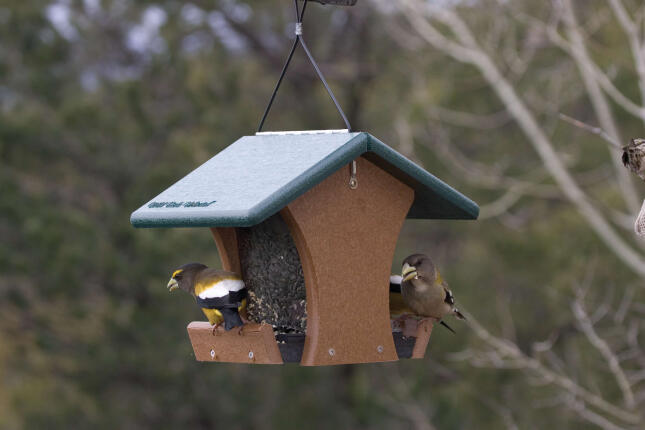
Compared to many finches, they show relatively low levels of fear around humans and often allow closer observation at feeders.